
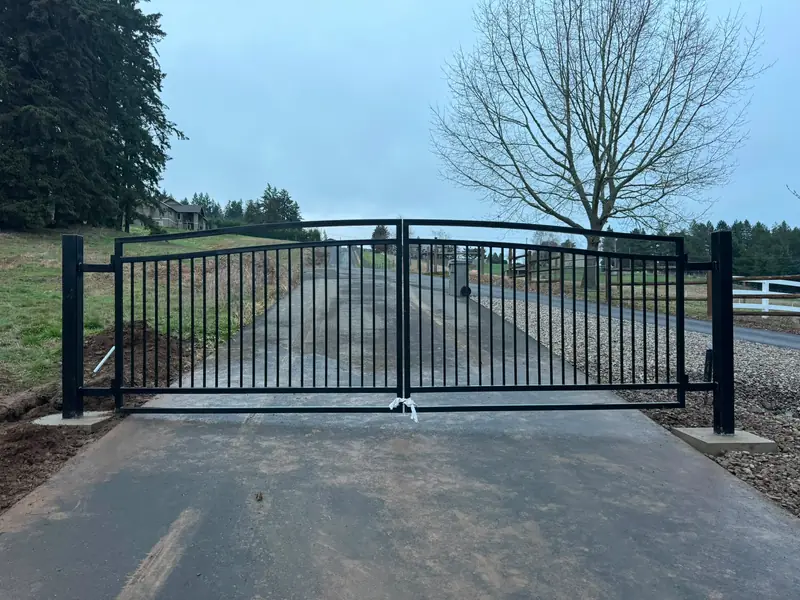
How swing gates work
A swing gate hangs on hinges from one or two posts and sweeps an arc, as a door does. Single leaf for narrower drives, double leaf when the span gets long or the look calls for it.
Its strengths are honest ones: the fewest moving parts of any gate type, the lowest build cost, the lowest automation cost, and easy manual operation when the power is out. A well-hung swing gate on good posts is the most durable machine we install.
Its demands are equally plain. The full arc has to stay clear of parked cars, planters, and snow piles, and the ground under that arc has to be close to flat. A driveway that rises toward the house will catch an inward-swinging leaf partway open, and the workarounds, from raised hinges to shortened leaves, cost money and look like workarounds.
How sliding and cantilever gates work
A sliding gate moves parallel to the fence line instead of sweeping an arc. Track gates roll on wheels along a rail set in the driveway. Cantilever gates skip the rail entirely: the gate carries a counterbalance tail and rides on rollers mounted to posts, so nothing touches the driveway at all.
That geometry is why slide gates win on sloped driveways, short setbacks where an arc would hang into the street, and any surface a track would hate, which around here means gravel drives, fir needles, and the occasional ice storm. Cantilever is our default slide type for exactly those reasons.
The cost is side room. The gate has to have somewhere to go when open: figure the width of the opening plus roughly half again for the counterbalance tail. Our custom gate builds start with a tape measure on that run of fence line.
Side by side
The honest comparison, assuming each type is installed where it belongs.
| Question | Swing | Slide / cantilever |
|---|---|---|
| Ground it needs | Flat, clear arc | Straight run beside the opening |
| Slopes | Poor without workarounds | Handles them well |
| Short setback from the street | Arc can hang into traffic | No arc, no conflict |
| Gravel, needles, snow | Fine if the arc is kept clear | Cantilever ignores them; track gates need a clean rail |
| Cost to build | Lower | Higher |
| Cost to automate | Lower | Higher, weight-rated operators |
| Moving parts to maintain | Hinges | Rollers, guides, chain |
| Manual use in an outage | Easy | Heavier, uses a release |
Neither column is the winner's column. A swing gate forced onto a sloped drive and a cantilever squeezed into a blocked side run both fail the same way: expensively, and after the check clears.
What automation changes
Both types automate well, with different hardware. Swing gates take arm operators, one per leaf. Slide gates take a chain-drive operator rated to the weight of the gate, and a big cantilever gate weighs more than people expect once the counterbalance is counted.
Safety is not a menu option. UL 325, the standard every legitimate operator is built and installed to, requires monitored entrapment protection: photo eyes, edge sensors, or both at each point where the gate could trap a person, wired so the operator will not run if a device fails. Any installer who shrugs at that requirement is telling you who they are. Our gate opener installations include the entrapment devices, sized and placed for your gate, in the written price rather than as an upsell.
The three measurements that decide it
Bring taste to the design; let the site pick the type. Three numbers do the picking.
Driveway pitch. Close to level through the arc, swing stays in the running. A rising or crowned drive points to a slide.
Setback. The distance from the street to the gate. Deep setbacks give a swing room to breathe and give visitors a place to stop. A gate near the sidewalk usually forces the slide.
Side room. Enough clean fence line beside the opening, and the slide is available; blocked by a garage, a hedge, or the property corner, and it isn't, whatever the slope says.
We measure all three at the free estimate and tell you which type your site is asking for. And if an existing gate is fighting you now, our gate repair crew can often re-hang or re-track it for far less than a new build.