
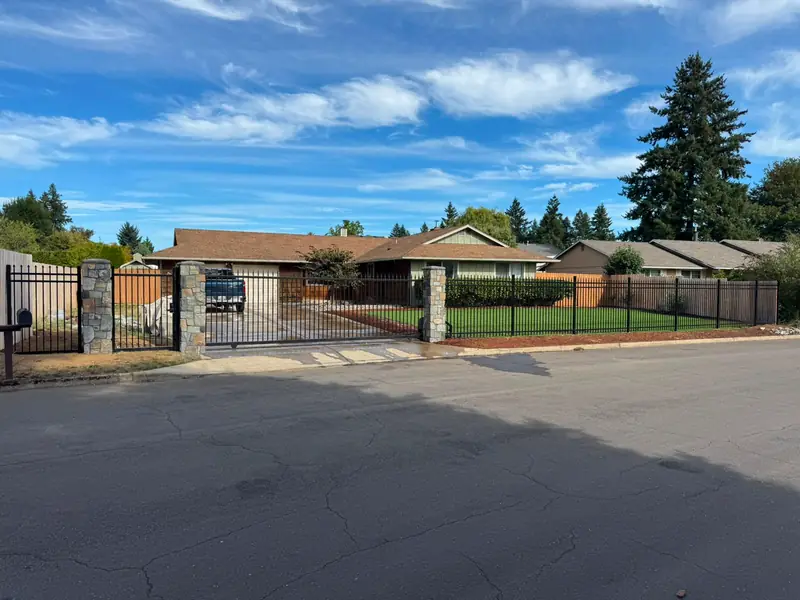
How tall the fence needs to be
Height is the first decision, and the honest answer follows the dog in front of you, not the breed chart. This is trade guidance from crews who build for dogs every week, not a law or a guarantee:
- 4 feet holds small and calm dogs, the ones who bark at the fence but have never tried to beat it.
- 5 feet covers most medium dogs with ordinary motivation.
- 6 feet is the answer for large or athletic breeds, and for any dog of any size that has cleared a fence before. A known jumper is an athletic dog no matter what the scale says.
One constraint comes from outside the yard: city zoning caps fence height, usually at 6 or 7 feet in side and rear yards and much lower out front, so the dog's number and the city's number both have to work on your lot.
Diggers: close off the ground line
A digger doesn't go over, it goes under, and the fix belongs at grade, not up top. Four approaches, in rough order of effort:
- Buried wire apron. Galvanized fence fabric runs down the fence line and bends outward below the sod in an L shape. The dog digs, hits wire, and quits. It disappears once the grass grows back.
- Concrete mow strip or curb. A poured strip under the fence line stops digging permanently and makes mowing easier as a bonus. The sturdiest answer for a committed digger.
- Pavers at the base. A row of pavers set tight to the fence discourages casual diggers and installs in an afternoon.
- Fabric below grade. On chain link, the mesh itself can extend below the surface during installation, which costs little when it is planned ahead.
Tell us your dog digs before we build, and the ground-line defense gets designed in rather than bolted on later.
Climbers, sightlines, and what the fence face does
Some dogs climb, and they climb what the fence hands them. Horizontal rails on the dog's side are a ladder. The diamonds of chain link give a determined climber toe grips. A smooth, flush face gives paws nothing at all. If you have a climber, put the structural rails on the outside face, or pick a style with a clean interior face, like a flush-board cedar fence or a smooth vinyl panel.
The other half of the equation is what the dog can see. Chain link lets a reactive dog watch every squirrel, delivery driver, and neighbor dog go by, and some dogs spend the whole day rehearsing at the fence line. Solid privacy fencing takes the trigger away, and fence-fighting between neighbor dogs often stops when the sightline does. If your dog is calm, visibility is fine and cheaper. If your dog patrols and barks, a solid face is a training tool that never takes a day off.
Gate discipline: where most escapes happen
Ask anyone who has chased a dog down the street: the fence held, the gate didn't. Gates fail through hardware and through humans, and both have fixes.
Self-closing hinges take the human out of the loop, shutting the gate behind the meter reader, the kids, and you. Pair them with a latch that catches on its own weight, mounted high enough that a pawing dog can't work it. For true escape artists, a double-gate airlock does what no single gate can: two gates with a small vestibule between them, so one is always closed while the other is open. It is standard practice at every dog park for a reason, and we build residential versions as custom gates. Whatever you choose, walk the latch once a season; a gate that needs a lift and a shove to close is a gate someone will leave open.
Materials compared for dogs
Every material on this table keeps a dog in when it is built to the right height with the ground line closed. The differences live in the details.
| Material | Jumpers | Diggers | Climbers | Reactive dogs |
|---|---|---|---|---|
| Chain link | Good at 5 to 6 ft | Mesh can extend below grade | Climbable for a determined few | Full visibility, can fuel fence-running |
| Cedar privacy | Strong at 6 ft | Add apron or mow strip | Smooth if flush-faced, rails kept outside | Blocks triggers, calms fence-fighters |
| Vinyl privacy | Strong at 6 ft | Add apron or mow strip | Smoothest face available | Blocks triggers |
| Ornamental picket | Good at 5 to 6 ft | Add mow strip | Little to grip | Full visibility |
For pure dog duty per dollar, chain link is the workhorse. For a reactive dog, or a shared line with another dog on the far side, cedar or vinyl privacy earns its price back in quiet.