
Troutdale Fence Builders at the Mouth of the Gorge
This is the windiest fence territory in the metro area, and anyone who has lost panels in January knows it. We design for the gusts first and pick the pickets second.
Sitting where the Columbia River Gorge opens onto the metro area, Troutdale takes the region's east winds head-on, and fences here live or die on their engineering. We sink posts deeper than we would ten miles west, pull them closer together, and favor designs that pass pressure through instead of catching all of it. Cedar, vinyl, chain link, and iron all get built to that standard.
Most of the housing went up between the 1970s and the 2000s: ranches, split-levels, and 90s Craftsman styles on compact suburban lots. The builder-grade fences that came with those subdivisions are wearing out on roughly the same schedule, which is why so many of our days here are full replacements rather than single-panel patches. The estimate is free, and our licenses, bonds, and insurance are current in Oregon as well as Washington.
What the East Wind Does to a Fence
The Gorge funnels winter high-pressure systems straight across town, and the results made this place famous. A privacy fence is a wall of sail area, and when a gust slams it, the whole load transfers to the posts at ground level. Our answer is mechanical, not hopeful: embedment past what the standard tables ask, footings sized to the site's exposure, tighter intervals between posts on open runs, and rail connections that hold while a panel flexes. When a yard fronts open ground on its east side, we suggest picket layouts with narrow gaps that shed pressure rather than absorbing it. Homeowners sometimes want the tallest solid fence on the most exposed line of the lot, and part of the job is explaining what that fence will face by February.
From Cherry Park Cul-de-Sacs to the Sandy River
Neighborhoods like Cherry Park, Sunrise, and Sweetbriar were platted with fencing in mind: rectangular lots, clean corners, runs that make sense. The work there is careful replacement, with attention to whose side gets the finished face and where the gates should land. Closer to the river and Glenn Otto Community Park, moisture joins wind on the list of enemies, so ground-line details get extra care, drainage under the posts and board bottoms held clear of the soil. Along the Historic Columbia River Highway through the Town Center, older properties call for fencing that fits the streetscape, and ornamental iron often suits those frontages better than a solid cedar wall. McMenamins Edgefield anchors the visitor traffic through town, and plenty of nearby homeowners want street-facing fences that look good to more than the mail carrier.
Front Yards and Back Yards Follow Different Height Rules
The rulebook here is short: no permit is needed for a fence 4 feet or shorter in a front yard, or 7 feet or shorter along side and rear lines. That covers the standard 6 foot backyard privacy fence and most front picket projects in Troutdale without paperwork. Anything taller, or anything complicated like a retaining wall under the fence line, deserves a conversation before the digging starts. Rules change, we confirm current requirements with the city as part of every quote.
Fence and gate services in Troutdale
- Cedar Fence Installation in Troutdale · Western red cedar privacy and picket fences, built post-by-post for Northwest weather.
- Vinyl Fence Installation in Troutdale · Low-maintenance vinyl privacy and picket fencing that won't need staining, ever.
- Ornamental Iron Fencing in Troutdale · Wrought-iron-style steel and aluminum fencing: security and curb appeal that lasts decades.
- Chain Link Fencing in Troutdale · Galvanized and vinyl-coated chain link for yards, kennels, and commercial perimeters.
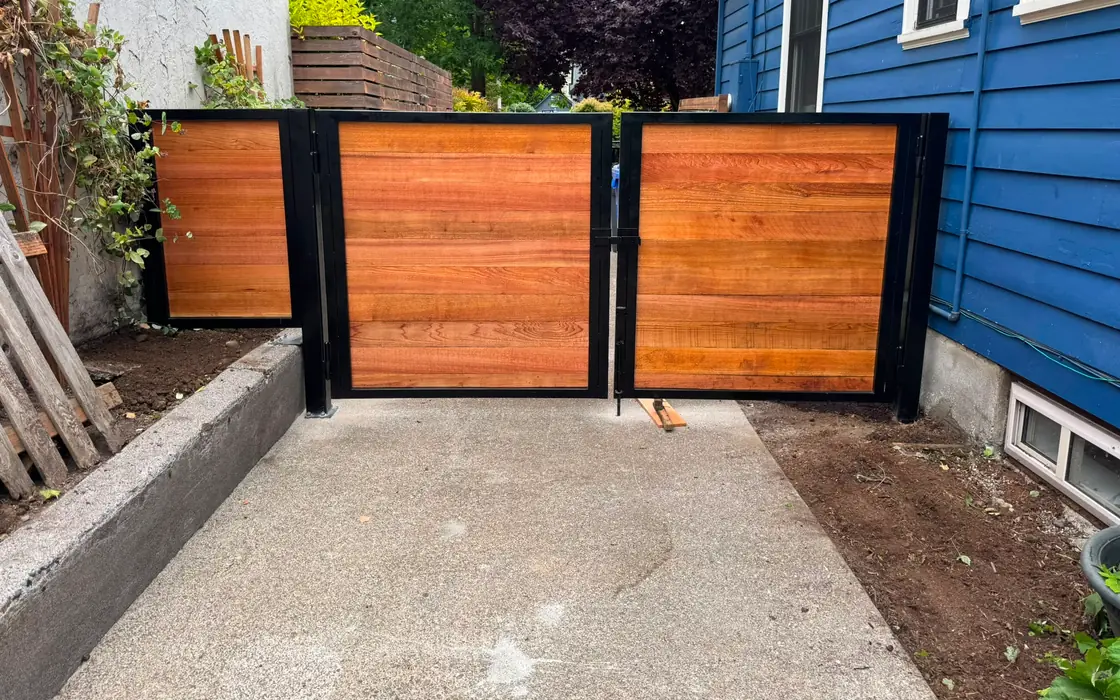
- Custom Driveway & Yard Gates in Troutdale · Driveway, garden, and side-yard gates built to match your fence and hung to swing true.
- Fence Repair & Replacement in Troutdale · Storm damage, leaning posts, and rotten sections, repaired or replaced honestly.
Good to know
Fencing in Troutdale: common questions
Every January I see fences flat along the roads here. How do you keep yours up?
We treat wind load as the design problem, not an afterthought. Posts go deeper than a standard install, footings get more concrete, spacing tightens on unsheltered lines, and rail connections are built to flex without letting go. Where a run takes the brunt, we recommend patterns that let some pressure pass through. The extra work is invisible when we leave and obvious by winter.
One bid came in far below the others. What is the catch?
In this town, the catch is usually at the bottom of the post hole. Shallow embedment and skimpy footings are invisible on the day of installation and cost nothing to promise. The wind will audit that work every winter, and it does not grade on a curve. Ask every bidder how deep the posts go and how much concrete each one gets, then compare.
What are the permit rules for a new fence?
Kinder than most people expect. The city requires no permit for fences 4 feet or under out front, and up to 7 feet along the sides and back, which covers the typical privacy fence and front picket work. Taller structures or unusual site conditions can change that answer, so we verify against your specific plans before anything is scheduled.
Our place is near the Sandy River. Does the damp change how you build?
It changes the ground-line details. River-corridor lots hold moisture longer, so we give every post a drainage base, use material rated for wet soil where wood meets earth, and keep the bottoms of the boards up out of the splash zone. Wind gets the headlines here, but water at grade quietly takes down nearly as many fences as gusts do.
Is vinyl a bad idea in this much wind?
Not if it is specified for the site. Standard vinyl at standard spacing struggles in the strongest events, so we shorten the span between posts, upgrade the structural components, and anchor everything into properly sized footings. Some exposed sites are still better served by cedar with airflow gaps or by ornamental iron, which barely notices wind, and we will say so when that is true.
Should my driveway gate swing or slide, given the gusts?
On exposed lots, a slide gate often wins because it moves along the fence line instead of swinging through the wind like a door. Swing gates still work where the approach is sheltered or the design is open, like ornamental iron with pickets the wind passes between. We look at your driveway's exposure and grade before recommending either.
A wind event took down half my fence. Do I have to replace all of it?
Not necessarily. If the standing sections have solid posts and sound rails, we can rebuild the downed run and tie into what survived. The honest caveat: when one half failed from shallow posts, the other half usually shares the defect, and we point it out when you are about to buy the same failure twice. An on-site look settles it, and looking is free.
The cedar we put in last summer is already losing its color. Is that normal?
Completely normal, and it happens faster at this end of the county because wind-driven rain and hard summer sun work the surface over. Untreated cedar weathers to gray without losing structural life; the change is cosmetic. If you prefer the fresh-cut tone, stain it once the wood has fully dried, typically one to two months after installation, and pick a dry forecast window so it bonds. Recoating then becomes part of routine upkeep.
Our subdivision lot looks like a clean rectangle on paper. Do we still need a survey before fencing?
Often not a full one. Subdivision plats from the 70s through the 2000s usually left iron pins at the corners, and a surveyor can locate those recorded monuments for a fraction of what a boundary survey of the whole parcel runs. We build to markers like that, or to a line the two owners show us. What we cannot do is decide where the boundary is; that authority belongs to licensed surveyors.
Half my fence blew down in December. Should I wait for summer to rebuild it?
No reason to wait. We install through the winter, and the wet season does not compromise the work; concrete hardens by chemistry, not evaporation, so a rainy pour still reaches full strength. Prolonged cold near or below 40 degrees is the one condition needing extra steps, and it seldom lingers even when the Gorge wind bites. Rebuilding in February also lets you skip the spring backlog that typically stretches everyone's lead times.
Planning a fence in Troutdale?
Free written estimates, honest advice on materials, and a crew that treats your property like its own. Call or send the details.