
The east wind is a real thing, not a sales pitch
Every winter, cold dense air pools east of the Cascades and drains west through the Columbia River Gorge, the only near-sea-level gap in the range. The result is a gap wind that can blow hard for days at a stretch, and the National Weather Service issues wind advisories for the corridor when it winds up, with the strongest gusts running from Washougal and Troutdale eastward.
If you live in Troutdale, Fairview, east Gresham, Camas, Washougal, or the eastern edge of Vancouver, none of this is news. What matters for your fence is that it stands broadside to that wind all season, and construction that holds up fine in Beaverton gets tested here every single year.
Why solid fences fail in wind
A 6 foot solid privacy fence is a sail. Each 8 foot panel puts about 48 square feet of surface in front of the wind, and a solid fence asks its posts to stop every bit of that force.
The posts pay for it with leverage. Wind pushes at the middle of the panel, several feet above grade, while the post is anchored at the ground line, so the force works like a pry bar with the footing as the fulcrum. Wood posts snap right at grade, where moisture has been weakening them the longest. Footings in soft, saturated winter soil rock loose and the run starts to lean. Fasteners pop and panels leave the property. And a fence rarely fails all at once: it fails at the weakest post, then the wind gets a grip on the loose end and unzips the run panel by panel.
What wind-rated construction means
Wind-rated is not a product you buy off a shelf. It is a set of building decisions, and each one is boring on its own:
- Deeper embedment. Posts go deeper than the standard rule of thumb, with larger concrete footings, so the lever has a longer handle on our side of the equation.
- Tighter post spacing. Six foot centers instead of eight cuts the sail area each post carries by a quarter.
- Heavier posts. Steel posts inside a cedar fence, or thicker-wall vinyl posts, resist snapping at the ground line where wood is weakest.
- Reinforced rails on vinyl. Aluminum or steel stiffeners inside the rails keep panels from flexing out of their pockets in a gust.
- Board patterns that bleed wind. Spaced pickets, shadowbox, and semi-private designs let a share of the wind pass through instead of asking the posts to stop all of it.
These choices cost more per foot than standard construction, and less than rebuilding the fence in February.
Materials, ranked for wind country
Chain link is nearly windproof. The wind passes through the mesh instead of pushing on it, which is why highway and industrial fencing in the Gorge is overwhelmingly chain link. It will outlast several storms' worth of privacy fencing and costs less to begin with.
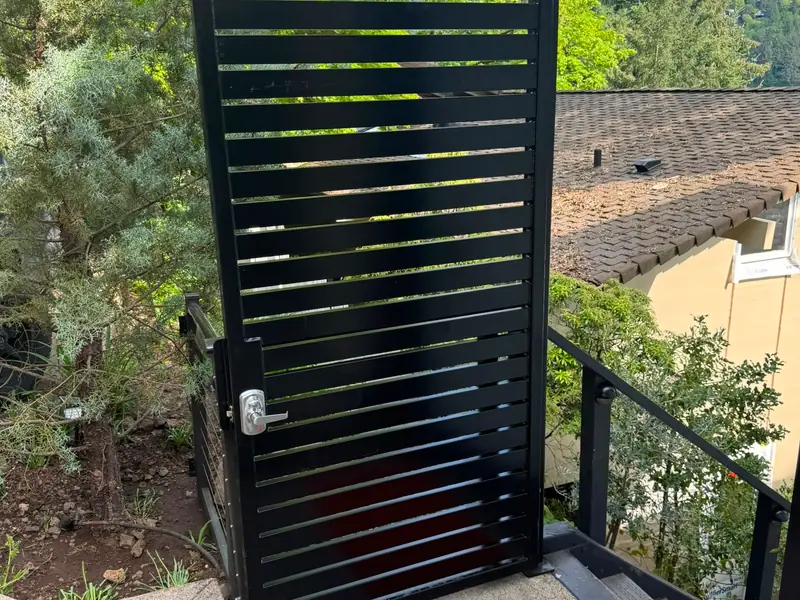
Ornamental iron and aluminum with open pickets are excellent for the same reason: air moves between the pickets, and the material itself has no interest in rotting or flexing. For street-facing frontage in the wind zone, it is hard to beat.
Solid cedar and solid vinyl are where engineering earns its keep. Both can stand in the corridor, but only with the wind-rated construction above, and vinyl specifically needs heavier-gauge panels with reinforced rails, not the big-box kind. A semi-private cedar pattern is often the honest compromise: most of the privacy, a fraction of the sail.
The morning after: storm repair triage
When a windstorm takes a section down, the order of operations matters more than speed.
- Photograph everything before you touch it. Wide shots and close-ups, from both sides if you can get them. Homeowner policies commonly handle fences under other structures coverage, but what is covered and what the deductible looks like varies by policy, so confirm the specifics with your agent before you decide anything.
- Make it safe. Clear the sidewalk, secure pets, and prop or rope off anything leaning over a walkway.
- Do not rush demolition. A leaning run with sound posts is often repairable; tearing it out in a hurry can turn a repair into a replacement.
Then get an assessment. Our wood fence repair crews spend every east-wind season in this corridor, and we will tell you plainly which posts survived and which did not.