
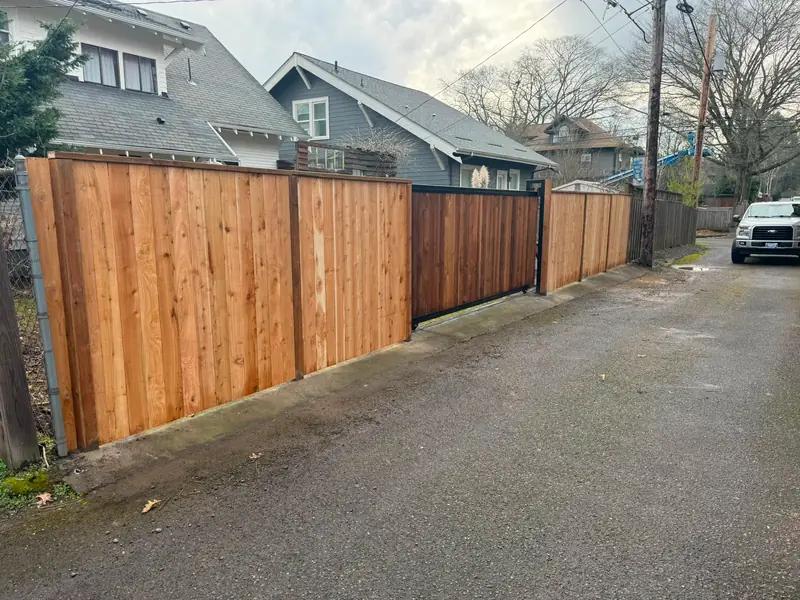
The short answer
Staying ten-plus years and never want to think about the fence again? Vinyl usually wins the math. Want warmth, a fence you can repair board by board, and a lower price on day one? Cedar. Everything below is the reasoning behind that one paragraph.
Side by side
| Question | Cedar | Vinyl |
|---|---|---|
| Cost up front | Lower in most configurations | Higher up front, near zero after |
| Lifespan (built right) | 20–25 years | 25–30 years |
| Maintenance | Optional stain, occasional board replacement | Rinse it |
| Repairs | Board by board, cheap and easy | Panel swaps, modular but pricier parts |
| Look | Warm, natural, weathers to gray | Uniform, crisp, stays one color |
| Wind performance | Strong when post spacing is right | Strong only in heavier-gauge systems |
| Shade and moss | Wants airflow and a ground gap | Doesn't care, may grow surface film |
| HOA friendliness | Depends on the standard | Often the specified material in newer subdivisions |
Where cedar wins
Older neighborhoods where a white plastic wall would look like a spaceship landed: the bungalow blocks of inner Portland, downtown Milwaukie, historic Oregon City. Budgets that want maximum fence on day one. Owners who like that a cedar fence can be fixed with a board and an hour instead of a part order. And anyone who plans to stain, because a freshly stained cedar fence is still the best-looking perimeter money buys here.
Where vinyl wins
Newer subdivisions where the HOA already speaks vinyl: much of Happy Valley, River Terrace, Fisher's Landing. Rental properties and busy owners who will never schedule maintenance. Long uniform runs where a crisp consistent line matters more than warmth. And wet, shaded lots where an owner doesn't want to think about wood care at all, provided the panels are the heavier-gauge systems we install rather than the bargain-store kind that crack in a cold snap.
What our climate does to each
Nine wet months test cedar at exactly one place: where wood meets ground. Posts set in concrete below the rot line, boards gapped off the soil, and stainless or hot-dipped fasteners solve most of what people blame on the material. Vinyl shrugs at rain but answers to wind: out toward the Gorge mouth in Troutdale, Camas, and Washougal, panels act like sails, so we tighten post spacing and reinforce rails no matter which material you pick. Neither fence fails because of what it's made of. Fences fail because of how they're built.