
Dog Yards and Garden Lines on a Working Budget
Plenty of homeowners call us wanting a secure yard for less than a privacy fence costs, and chain link is how that math works. A four or five foot galvanized run keeps a retriever home, encloses a garden against rabbits, and closes off a side yard without touching the savings account. For street-visible lines, the black-coated option earns its modest premium: against shrubs and bark dust the mesh reads as a thin dark outline instead of bright wire, and the finish shrugs off the wet season. What separates our installs is tension. Fabric pulled drum-tight between well-anchored terminal posts stays flat and square for decades, while a slack install sags into an eyesore within a few winters. Every post gets its own concrete footing, and every run gets stretched with proper tensioning tools, never by hand.
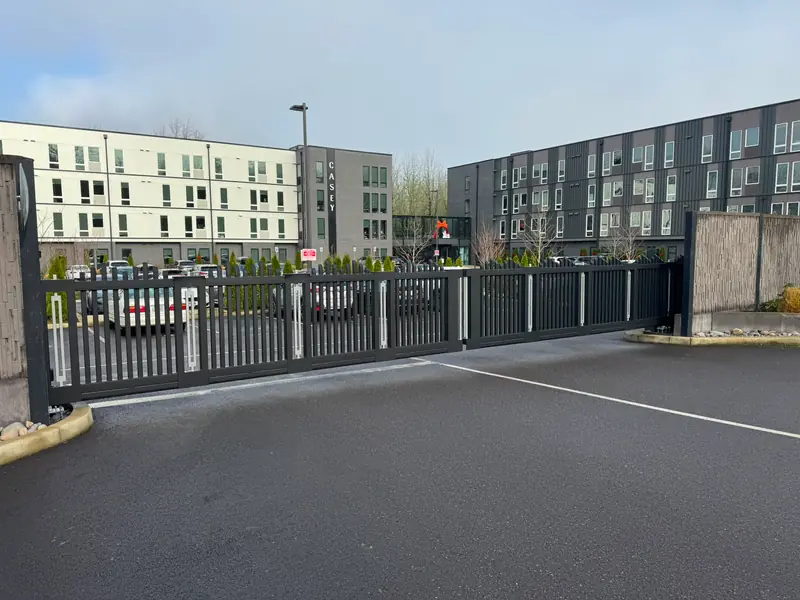
Perimeter Fencing Along the Industrial Corridors
From Swan Island to the warehouse blocks off Columbia Boulevard, we build the security side of the trade: taller galvanized perimeters with top rail, tension wire holding the ground line, and heavier framework where trucks and forklifts operate close to the fence. Contractor storage, tow lots, self-storage rows, and shop yards each carry their own theft pressure, so we spec fabric weight and post schedule to the site instead of quoting one recipe everywhere. Cantilever slide gates keep entrances clear of gravel and drainage swales, and slat inserts or mesh windscreen can hide inventory from the street where that helps. Property managers get one contact, straight scheduling, and paperwork squared away before mobilization. When an existing perimeter has been cut or flattened by a vehicle, we splice and re-stretch rather than pushing a full rebuild you may not need.
What Happens After You Book the Job
Every project starts with a walk of the line and a written number that holds. From there the sequence is short:
- Utility locates called in before any digging
- Terminal and line posts anchored in poured footings and left to cure
- Rails fitted and fabric stretched tight in one pass
- Gates hung, latched, and swing-tested while you watch
- Wire scraps and old fencing hauled off the property
Most residential yards finish inside a week from the first post hole, and we leave the site clean enough that the only evidence is the fence.
Want the deeper dive? Read our full chain link fencing page, or see everything we build on our Portland fence company page.