
The Below-Grade Spec That Keeps Cedar Upright
Wind failure is a foundation failure wearing a wood costume. When a six-foot solid panel catches a hard gust, the force multiplies down the post and tries to lever the footing out of soil that January has already turned to pudding. Our answer is boring and effective: holes dug deeper than the flatland standard, concrete volume matched to each panel's sail area, and posts placed closer together wherever a run faces open ground toward the Gorge. We also upsize the rail-to-post connection, because a joint that carries load only in calm weather is not a joint, it is a suggestion.
None of this appears in a photo of the finished fence, which is exactly why cheap bids skip it. Ask any bidder to state hole depth and bag count per post, then compare.
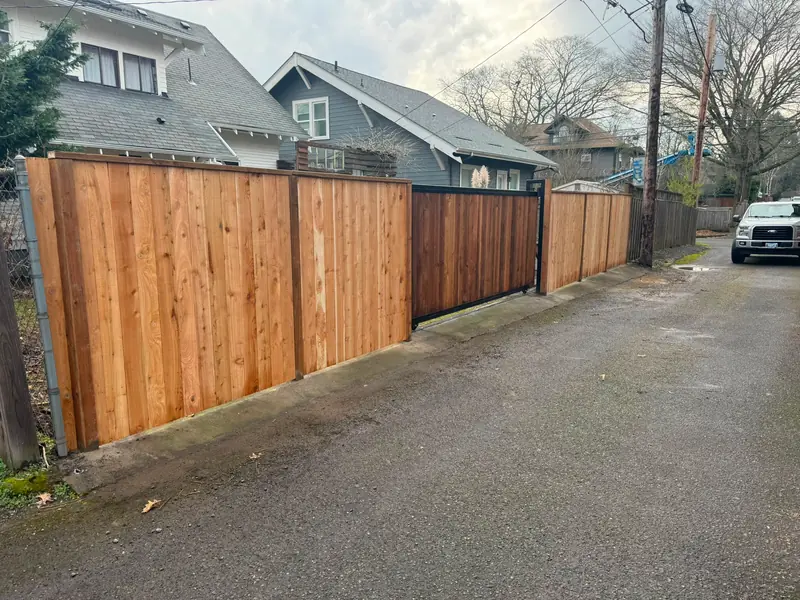
Keeping Privacy Without Building a Sail
The instinct after losing a fence is to rebuild it stronger and equally solid. Sometimes the smarter move is a touch less solid. An overlapped board pattern blocks sightlines completely while leaving thin vertical channels where moving air slips through, and the relief that provides on a gusty night is substantial. Louvered and spaced-picket designs go further for yards that value airflow over total screening.
Placement matters as much as pattern. A run tucked behind the house rarely needs the full wind treatment, while the same fence turned to face open fields takes the season's whole output. We rate each leg of your layout separately during the estimate, so you pay for wind engineering only on the stretches that need it.
The Wind Build, Step by Step
Every exposed-run cedar project follows the same sequence: walk the property and map its exposure leg by leg, write a quote that names depth and spacing for each stretch, then dig, pour, and let footings harden before a board goes on. Panels come last, fastened with ring-shank nails that grip through wet-dry cycles.
- Each run rated for its own exposure
- Embedment and spacing figures put in writing
- Footings sized to panel height and pattern
- Overlap or louver options for exposed stretches
- Gates braced and latched for gusty nights
Want the deeper dive? Read our full cedar fence installation page, or see everything we build on our Gresham fence company page.