
When Every Fence on the Street Turns Forty Together
A tract neighborhood gets fenced once, fast, by the lowest bidder the builder could find, and the clock starts ticking on every post at the same hour. Decades later one section drops in a storm, then a gate two doors down quits latching, and within a couple of summers the whole loop is patching. That is the moment to coordinate instead of patch. When several households along a shared run rebuild together, tear-out gets consolidated, the crew mobilizes once instead of four times, and the finished line holds one height, one color, and one straight top from corner to corner instead of changing character at every property break. We will gladly walk a group of yards in one pass, write each household its own number, and sequence the demolition so no dog spends a night uncontained.
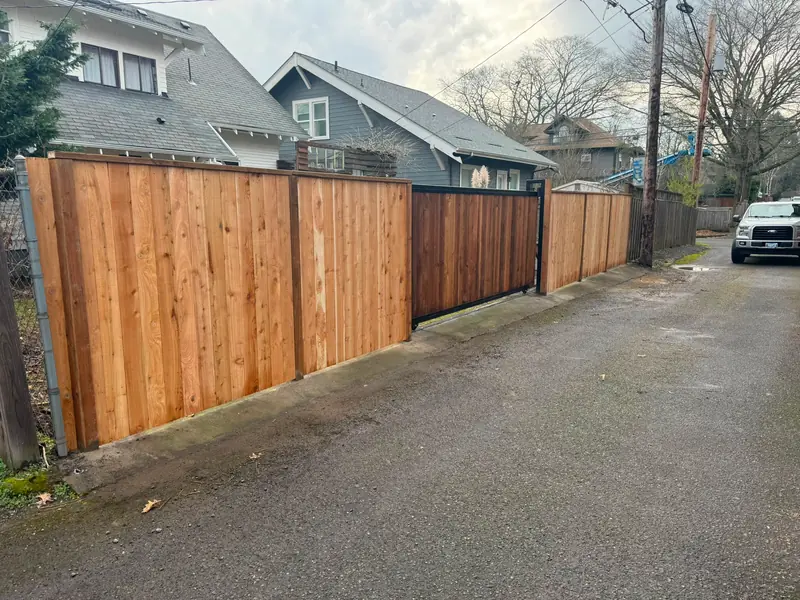
Passing the Design Review While Fixing What the Builder Skipped
Architectural committees care about what shows: height, cap profile, stain tone, whether the pattern matches the street. We build to that spec exactly, and we upgrade everything the spec never mentions. The original tract fences typically had posts stopped short of proper depth, rails toenailed instead of hung on brackets, and boards planted straight in the mud. Round two gets full-depth footings over drain rock, rail hangers that hold through decades of wet-dry cycling, and a deliberate rot gap under the bottom edge.
Layout deserves a second look too. Thirty years of living reveals where the first fence went wrong: a gate on the wrong side of the yard, no access for the mower, a corner that traps leaves. Rebuilding is the one cheap chance to correct all of it.
How a Multi-Yard Rebuild Gets Sequenced
Group rebuilds live or die on sequencing, so we phase them: demolition across every participating yard first, then posts set in one continuous run so the concrete cures as a unit, then boards, caps, and gates yard by yard. The line never sits open overnight, and each owner signs off on their own scope before demolition begins on any of them.
- One written quote per household, no lump-sum confusion
- HOA submittal drawings prepared for you
- Tear-out, haul-away, and old footing removal
- Stain matched and applied after the boards season
- Gate hardware upgraded the whole run
Want the deeper dive? Read our full cedar fence installation page, or see everything we build on our Beaverton fence company page.