
When the Grade Picks the Gate for You
A driveway that climbs from the road settles most gate debates before style ever comes up. A leaf swinging uphill grounds out within a few degrees of travel, and one swinging toward the street needs room a sloped frontage rarely offers. So the grade gets measured before anything is drawn. Where a level shelf exists behind the entry, a slide gate rolling on a track, or hanging cantilevered past the opening, handles slopes a swing design cannot. Where the approach flattens at the road, a swing entry stays on the table, sometimes with rising hinges that lift the leaf as it opens. We take grade readings across the approach at the first visit and show you which layouts your driveway will accept, with honest notes on what each costs to do well.
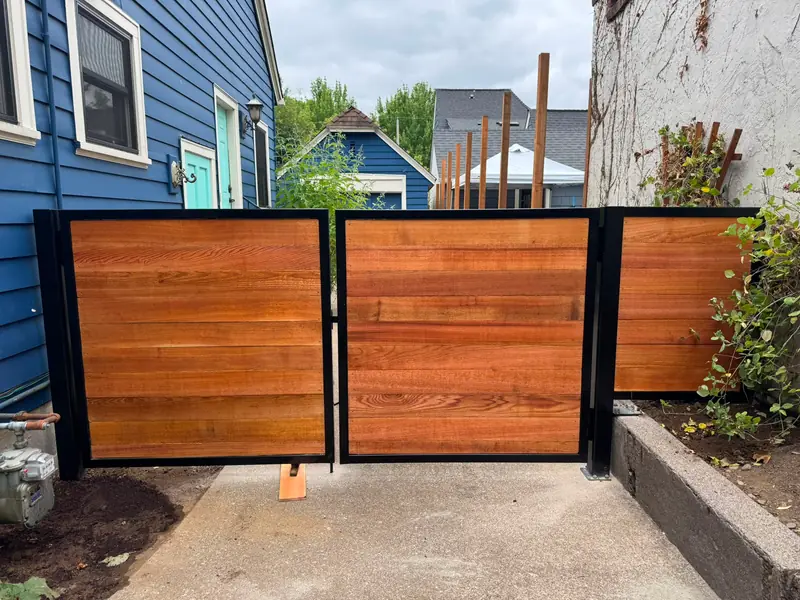
Wood Warmth on a Steel Backbone
Wide entries look best in wood and last longest on steel, so we build both into one gate. A welded frame carries the span and keeps the leaf from racking as the seasons turn, while cedar or tight-grain fir cladding gives the entry the warmth a timber-and-stone house calls for. The steel disappears entirely once the boards go on, and the hinges bolt to metal rather than to lumber that will compress around lag screws over the years. On view properties above the rivers, we often pair a clad gate with open metal fencing along the frontage, so the entry makes its statement and the panorama stays intact. Every frame is sized to its own opening in our shop, primed and coated before a single board touches it.
What the Process Looks Like
An entry gate project here usually starts with a conversation at the bottom of the driveway. We measure the opening and the grade, look at where cars stack when the gate is closed, and ask what the entry should say about the property. The quote that follows itemizes fabrication, posts and footings, hardware, and finish, with automation priced as an option whether you want it now or want the conduit placed for later. Fabrication happens in our shop; installation is typically a two-visit sequence, footings first, gate second, so concrete cures before it carries weight. Before we leave, you get the hinge adjustments demonstrated and a written record of what was built.
Want the deeper dive? Read our full custom driveway & yard gates page, or see everything we build on our West Linn fence company page.